Published May 11, 2022. The law has changed since: in March 2026 the SEC issued Release No. 33-11412, which supersedes the SEC staff’s 2019 Framework for “Investment Contract” Analysis of Digital Assets discussed below. See Crypto Lending, Staking & Yield Platform Losses.
The SEC’s February 14, 2022 settlement with BlockFi, under which BlockFi agreed to pay $100 million in penalties, was a monumental legal moment for the cryptocurrency and DeFi space. While the event shed some regulatory insight and, in the SEC’s words, showed its willingness to work with crypto platforms on how they can come into compliance, it also raised some issues that may implicate the industry as a whole.
What is BlockFi? And what happened?
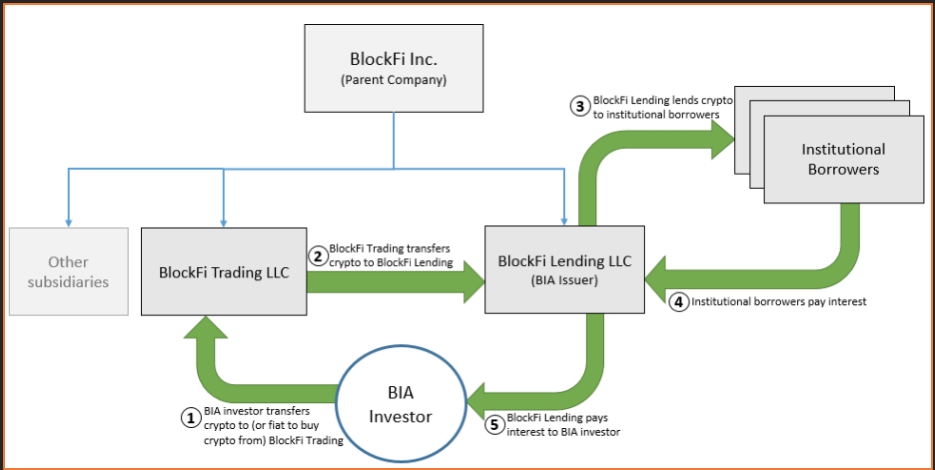
BlockFi was a crypto finance company headquartered in New Jersey that allowed its users to trade, hold, and borrow cryptocurrency through an array of products, and it filed for Chapter 11 bankruptcy on November 28, 2022. In March 2019, the company began offering BlockFi Interest Accounts, which allowed users to lend their deposited cryptocurrency and, in exchange, receive interest. Some of these BlockFi Interest Accounts (“BIA”) offered a 9.5% annual yield, which dwarfed the average bank savings account rate of 0.06% at the time. BlockFi would then pool investors’ crypto holdings together, and lend it to institutional borrowers. These borrowers would then pay interest to BlockFi, who would take a cut and redistribute the interest to the BIA holders. BlockFi would typically adjust the BIA rates monthly in correlation with how much yield the company received from lending to institutional borrowers.
The product was a hit. As of March 31, 2021, BlockFi held about $14.7 billion in BIA investor assets, and by December 2021 it had about 572,000 BIA investors. State securities regulators had begun acting against BlockFi over the offering and sale of these BIA accounts by July 2021, and the SEC also investigated them. The SEC settled with BlockFi, finding that the company violated Sections 5 and 17(a) of the Securities Act and Section 7(a) of the Investment Company Act. Ultimately, BlockFi agreed to pay $100 million: a $50 million penalty to the SEC and an additional $50 million in fines to 32 states.
Going Forward for BlockFi
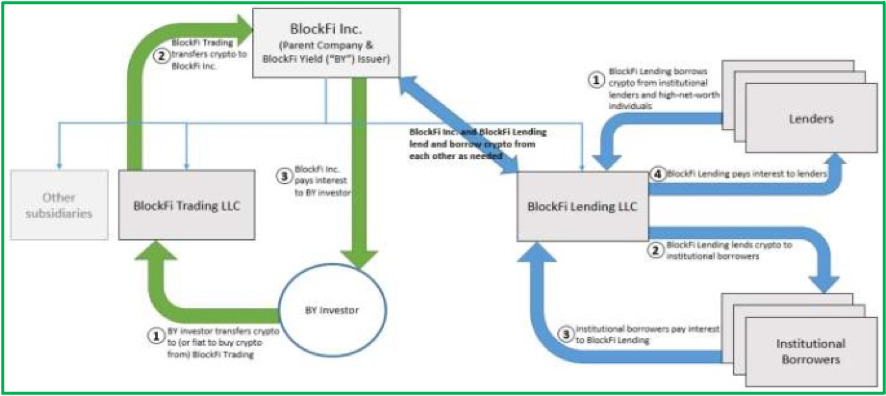
BlockFi had to stop offering BIAs to new investors in the United States immediately, though it could continue to service existing accounts. However, existing U.S. BIA holders could not deposit more funds into these accounts. Additionally, BlockFi had 60 days (from 2/14/22) to come into compliance with Section 7(a) of the Investment Company Act, either by filing a notification of registration under Section 8(a) or by completing steps so that it no longer had to register, and the SEC staff could grant a single 30-day extension for good cause. In addition, BlockFi’s parent, BlockFi Inc., announced that it intended to register the offer and sale of a new product, BlockFi Yield, with the SEC on a Form S-1 registration statement. Additionally, the planned registration was to include an indenture and a Form T-1 under the Trust Indenture Act (the trustee’s statement of its eligibility to act as trustee under the indenture, which is the written agreement with an issuer of debt securities such as bonds).
How did BlockFi Work? And How Will it be Structured?
Old Structure
New Structure
Let’s look at how the SEC applied some of the key securities law precedent to the company’s offering and sale of BlockFi Interest Accounts.
The SEC’s Howey Analysis of BIAs
The landmark case of SEC v. Howey is the primary tool used to determine whether certain transactions qualify as an “investment contract” under the Securities Act. If the transaction meets the 4 factors, it is considered a security and subject to regulation by the SEC. What are the 4 factors and how did the SEC apply them to BlockFi? A transaction is an investment contract if: (1) there is an investment of money; (2) an expectation of profits; (3) within a common enterprise; (4) where profit derives from the efforts of others;
The SEC stated that BlockFi’s BIAs constituted an “investment contract” under Howey because:
- [Investment of Money] BlockFi sold BIAs in exchange for the investment of money in the form of crypto assets.
- [Common Enterprise] Each investor’s fortune was tied to the fortunes of the other investors because BIA investors’ returns depended on BlockFi’s pooling and deployment of the loaned crypto assets. Additionally, BlockFi’s fortune was linked to the investors because the company earned revenue for itself through its deployment of the loaned assets.
- [Expectation of Profits] BlockFi created an expectation that investors would receive profits from the company’s efforts through managing the crypto assets.
- [Efforts of Others] The company had complete control and ownership over the borrowed crypto assets, indicating that profit was derived from their efforts.
SEC’s Application of Reves
Lost funds on a crypto lending or exchange platform?
Industria Business Lawyers advises on claims involving crypto lending, staking, and exchange platforms. Describe your matter and we will contact you to schedule a consultation.
Request a Consultation or call (202) 860-1210
Related services: Crypto Lending, Staking & Yield Platform Losses · Crypto Exchange & Platform Accountability · Investment Loss Recovery
The Reves test is an additional test used to determine whether a note should be considered a security. In Reves v. Ernst & Young, the Supreme Court held that a note should be presumed a security unless it bears a strong resemblance to one of the recognized categories of non-security notes. Whether a note bears a strong family resemblance is judged by 4 factors, which also decide whether a new category of non-security note should be recognized: (1) the motivation of seller and buyer; (2) the plan of distribution of the instrument; (3) the reasonable expectations of the investing public; (4) the presence of an alternative regulatory regime. Here’s what the SEC said on the 4 factors:
- BlockFi offered and sold BIAs to obtain crypto assets for the general use of its business, namely, to run its lending and investment activities to pay interest to BIA investors, and purchasers bought BIAs to receive interest ranging from 0.1% to 9.5% on the loaned crypto assets.
- BIAs were offered and sold to a broad segment of the general public.
- BlockFi promoted BIAs as an investment, specifically as a way to earn a consistent return on crypto assets and for investors to “build their wealth.”
- No alternative regulatory scheme or other risk-reducing factors exist with respect to BIAs.
Implications on the Industry
Impact of Alleged Material Misrepresentations (outdated information on your website)
BlockFi’s website claimed that their loans were “typically” “over-collateralized”. In reality, less than 24% of their loan portfolio was over-collateralized throughout the past 3 years. The SEC further alleged that through “operational oversight, BlockFi’s personnel failed to take steps to update the website statement to accurately reflect” these facts. As such, the SEC alleged that BlockFi violated Section 17(a)(2)(misstatement and omission liability claim) and 17(a)(3) (so-called “scheme” liability). While there is not private right of action for Section 17(a) violations as has been implied under Section 10(b) and Rule 10b-5(b), liability can reach a broader range of activity because no specific intent is required.
This enforcement action underscores the need for ongoing diligence to ensure the accuracy of information presented and representations made about a crypto or DeFi project through promotional materials, social media posts, and on websites as proof of scienter is not required to trigger potential liability. Misrepresentation regarding the overall status of collateralization is tough to defend. It’s important to note that the standard for review for this violation is negligence. However, there is a silver lining (perhaps). If information asymmetry is the problem, then perhaps DeFi is the solution. Regardless, websites should make sure that any information regarding material information is accurate. Our blockchain and digital asset attorneys advise platforms on exactly this kind of ongoing disclosure diligence.
Investment Company Act Concerns and Dissent within the SEC
The SEC also found that BlockFi violated Section 7 of the Investment Company Act. More specifically, Section 7(A) of the Investment Company Act holds that it is unlawful for an unregistered investment company to offer or sell any security via interstate commerce. HOWEVER, there is a catch (here comes the silver lining). The Investment Company Act specifically excludes any company that is primarily a “market intermediary” as defined in Section 3(c)(2) of the act. A market intermediary is any company that enters into transactions on both sides of the market. Section 3(c)(2) also covers businesses primarily engaged in underwriting and distributing securities issued by others or acting as a broker, if their gross income normally comes principally from that business. By meeting this definition, lending platforms can avoid regulation under the ICA because they will not be considered an “Investment Company”. Ultimately, the SEC found that BlockFi did not satisfy the terms of the market intermediary exclusion, and gave it 60 days either to register or to complete steps so that it no longer had to register.
SEC Commissioner, Hester Peirce, offered her dissent to this settlement decision and expressed her pause regarding the use of the market intermediary exception. For reference, the SEC has five Commissioners; when this article was written, the Chair was Gary Gensler, and the current Chairman is Paul S. Atkins. Commissioner Peirce expressed that the SEC was not always fair with good-faith actors like BlockFi. She also offered great insight into the practical implications of this settlement. Peirce explained that BlockFi is possibly in a Catch-22 because the company may not be able to register as an investment company via Section 8(a) of the Investment Company Act since they issue debt securities. The dissenting commissioner further warned that this market intermediary exemption is rarely used and may be problematic when applied to crypto companies.
Additionally, Commissioner Peirce was very skeptical of the timeframe given to BlockFi. She explained that expecting BlockFi to provide sufficient evidence that the company falls within an exception within 60 (plus 30) days is “extremely ambitious”. Alternatively, she offered, that the Commission could create a more tailored regulatory framework for BlockFi (and presumably other BIA companies) under Section 6(c) of the Investment Company Act. While her dissent merely outlines her frustrations, it could be indication that further regulatory clarity is on its way. And after President Biden’s March 9, 2022 executive order on digital assets (since revoked by Executive Order 14178 in January 2025), the industry had its fingers crossed.
Applicability of BlockFi Settlement for DeFi Arrangements
Although BlockFi marketed itself as one, the company may not have been the paradigm for DeFi lending platforms. The BIA loans were received, pooled, and reinvested by BlockFi. Then the interest payments were collected and redistributed by BlockFi. This does not seem that decentralized. Therefore it is difficult to ascribe the direct ramifications on all DeFi platforms considering their difference in structure. This was not the first time that the SEC brought an enforcement action against a D.I.N.O. (DeFi In Name Only) Company.
In 2008, the SEC brought an action against Prosper Marketplace, an online peer-to-peer lending platform where the company connected lenders and borrowers but did not let them learn each other’s true identities or transact directly. In the enforcement action, the SEC described how “Lenders rely on the efforts of Prosper because Prosper’s efforts are instrumental to realizing a return on the lenders’ investments.” Alternatively, sufficiently decentralized platforms, where the company does not control loan terms, how loans are transacted, or how the loans are paid off, may be able to avoid a similar fate to BlockFi and Prosper.
More recently, in the SEC staff’s 2019 Framework for “Investment Contract” Analysis of Digital Assets (since withdrawn and superseded by Release No. 33-11412), the staff stressed the importance of the Expectation of Profits and Efforts of Others prongs of Howey. However, this statement came at a time when the majority of the crypto space were Layer 1 token projects. It’s also important to note that it may be difficult to apply the Commonality test of Howey to DeFi platforms. Why? Because the decentralized nature of DeFi breaks the commonality between lenders, borrowers, and the platform. Additionally, it may be challenging to apply the Reves test to DeFi platforms. It is possible that DeFi could skirt away from the Reves test as a whole by making the argument that these loans are not notes. Typically, a note is a two-party negotiable instrument. With DeFi, the decentralized nature differs from the traditional bilateral structure since lenders and borrowers would be interacting directly with the protocol. Some have also asked whether limiting interest accounts to nine months could bring them within the securities laws’ exemptions for short-term notes, but those exemptions are narrow; the Securities Act exemption, for example, covers only notes that arise out of, or fund, current transactions.
SEC’s Recommended Pathway Going Forward
Although the SEC has claimed a crypto company was in violation of the Investment Company Act before, this is the first time the agency made allegations against a current crypto interest rate account company. The SEC’s recommended pathway for BlockFi and other crypto interest account offerors via Section 8(a) or an exception to the Investment Company Act is certainly novel. Previously, in 2018 settlements with two token issuers (Airfox and Paragon), the SEC required the companies to register their tokens as securities under Section 12(g) of the 1934 Act and file periodic reports under Section 13(a). Ultimately, however, BlockFi’s parent, BlockFi Inc., announced that it intended to register the offer and sale of a new product, BlockFi Yield, with the SEC on a Form S-1 registration statement.
Obviously, registering an offering with the SEC is a massive undertaking… but what if you are already a public company? There is a question of whether this reopens the door for Coinbase Lend, the interest program Coinbase dropped in September 2021 after the SEC threatened to sue. Remember, to rely on the market intermediary exclusion, BlockFi would have to be primarily engaged in regularly entering into transactions on both sides of the market for financial contracts. What could this mean for a company like Grayscale Trust, could they offer an additional product? Could we see players like SoFi make an Interest Account? Could we see cooperation among lending/borrowing companies to create more working capital in the space? Also, considering how costly it is for a company to go public, could we see crypto SPACs? Hopefully, regulatory clarity is on its way, DeFi companies can continue to offer competitive products, and the SEC can properly protect consumers.
If you lost funds on a collapsed or frozen crypto platform, our crypto fraud recovery attorneys can assess your options.
Related: if your losses came through a brokerage or advisory account rather than directly on a platform, see our FINRA arbitration practice and investment loss recovery overview.